Ch. 01
A thing with no fixed shape
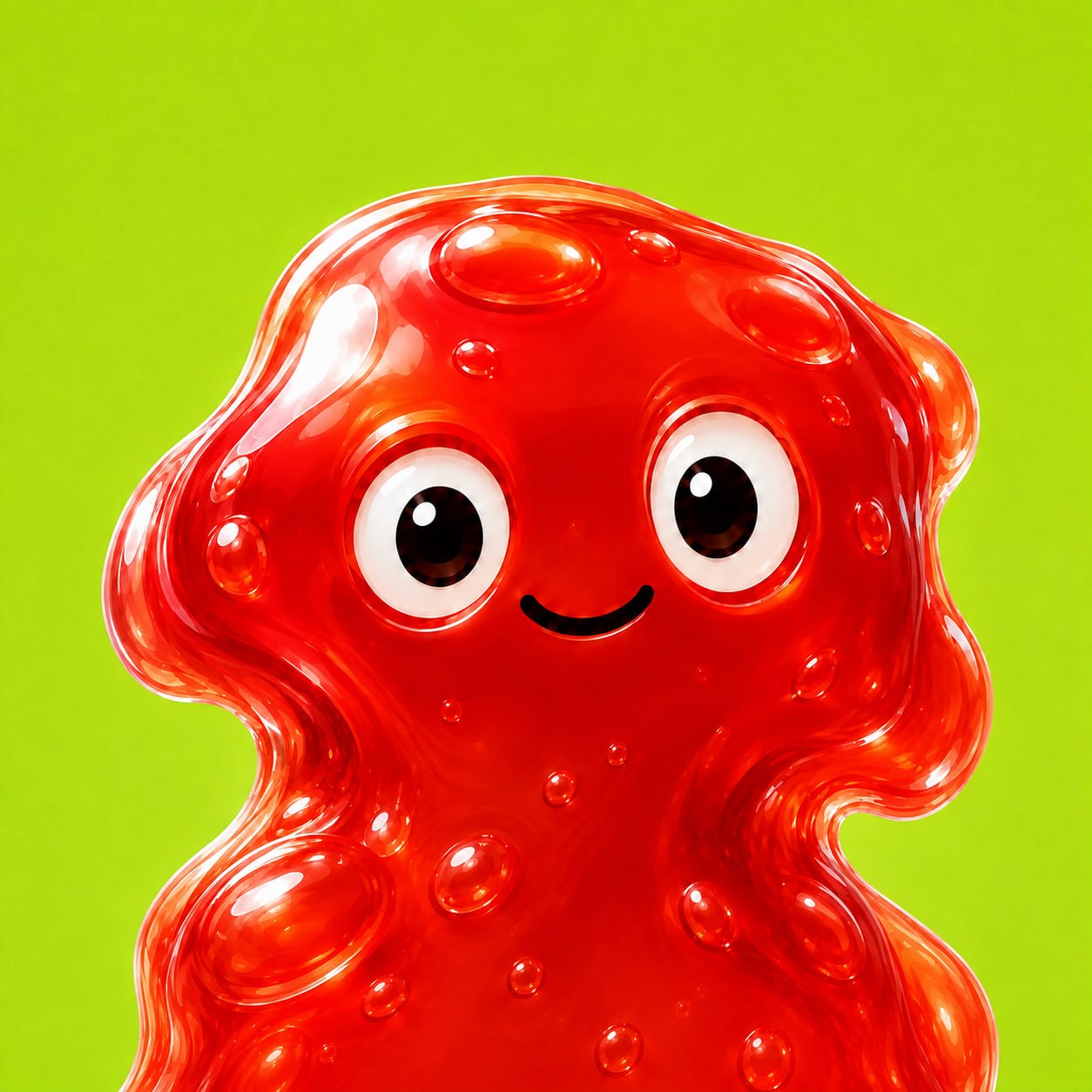
Gloopy is gelatinous. That is the first line of the file and, for a long time,
it was the only line anybody could agree on. Everything else about the specimen
resists the kind of language a survey is built from. It has no length, because it
has no orientation it keeps. It has no height, because height implies a top that
stays put. It has a volume, and the volume is the only number in the entire record
that has never once had to be corrected.
It has four limbs. It has six tentacles. It did not ask for either, and the
distinction between them is largely administrative — under load, a limb behaves
like a tentacle and a tentacle occasionally remembers it is supposed to be
load-bearing. Nothing in the body is rigid. Nothing in the body is even
reliably soft. It firms up when startled and slackens when comfortable,
which means the specimen is at its most structurally sound precisely when it is
having the worst time.
What holds it together is surface tension and, as far as the Surveyors can
determine, optimism. The first is measurable. The second was entered into the
record as a joke by a junior researcher and has never been successfully removed,
because in eleven years of observation nothing has explained the specimen's
behaviour better.
Elastic. Unstable. Structurally unsound. Entirely undeterred.
Survey summary, line 4
It is important to understand that Gloopy is not fragile. Fragile things break.
Gloopy has never broken. It has been compressed to a third of its resting height,
pulled to nine times its resting length, dropped from a surveying balloon, and on
one occasion mistaken for a jam and spread on something. In every case it
reassembled, wobbled twice, and looked around for what to do next. The problem was
never that Gloopy might come apart. The problem was that it never would, and
therefore nobody could work out what to do with it.
Ch. 02
How it was released
The Surveyors are a cataloguing body. This is worth stating plainly, because
almost everything that happened next follows from it. They do not protect things.
They do not study things, in the sense of wanting to know what they are for. They
find a thing, they measure it, they assign it to a drawer, and they move on to the
next thing. The system is enormously effective and has exactly one requirement:
the thing must have a shape.
Gloopy was found in Mossgut Valley, in a hollow under a wet stone, doing
nothing in particular. It was brought in. It was weighed — successfully. It was
measured — four times, producing four different answers, none of them wrong. It
was tested against the standard firmness scale, which runs from granite
down through clay, rind, curd and finally
regrettable, and it came in beneath the bottom of the scale by a margin
that required the scale to be extended downward for the first time in its history.
Then came the filing, and the filing did not happen. A drawer is a shape. A
label is a claim about what will still be true tomorrow. The clerk on duty spent
four hours attempting to enter the specimen and produced, in the end, a single
line: non-compliant with every known standard of firmness — recommend
release.
So they let it go. Not out of mercy, and certainly not out of interest. They
opened the door on the eastern side of the station, which faces the Wilds, and the
specimen went out through it at what the log describes as "an unhurried wobble."
It was assigned the reference number 001, because it was the first thing that had
ever defeated the drawers, and it remains the only entry in its own category.
Then somebody — and the record is genuinely unclear about who — decided to
keep watching. That decision is the reason this console exists.
Ch. 03
The wobble
Gloopy cannot stand still. This is not a behavioural quirk; it is a property of
the body. A rigid thing at rest stays at rest. A gelatinous thing at rest is still
settling, and settling overshoots, and the overshoot has to settle too. Put the
specimen on a perfectly level surface in a perfectly still room and come back an
hour later and it will still be moving, very slightly, in a decaying oscillation
that has never in recorded observation reached zero.
Every deliberate movement inherits this. Gloopy does not walk, it commits to a
direction and then negotiates with the consequences. It does not stop, it stops
applying force and waits for the world to take the momentum off it. It does not
jump so much as compress, panic, and release. Ask it to move one metre and it will
move somewhere between eighty centimetres and three metres, and the variance is
not error — the variance is the specimen.
Everywhere else, overshoot is a flaw. Out here it is the only
thing that gets you across the gap.
Field note, Sunbleach Ridge, entry 4,102
In a laboratory this is a defect, and it is why the specimen failed every test
put in front of it. In the Wobbly Wilds it is the whole toolkit. The gaps are too
wide for a controlled step and the surfaces are too unreliable for a controlled
landing. A creature that moves exactly as far as it intends to move gets to the
edge of Mossgut Valley and stops there forever. Gloopy overshoots the edge, panics
mid-air, hits the far wall at the wrong angle, deforms around it, and arrives.
It is not good at this. That is worth saying clearly, because it would be easy
to read the above as competence. Gloopy is bad at moving in a way that happens to
be survivable. Those are different things and only one of them is on the record.
Ch. 04
The Wobbly Wilds
Six regions, charted in the order the specimen blundered into them. The
designations in brackets are from the first survey, before anyone had walked the
ground; several are wrong and are kept only so the old maps still resolve.